Collecting
Perhaps the most immediate benefit of capturing content outside our heads is that we escape what I call the “reactivity loop”—the hamster wheel of urgency, outrage, and sensationalism that characterises so much of the Internet. The moment you first encounter an idea is the worst time to decide what it means. You need to set it aside and gain some objectivity.
What to collect? Richard Feynman’s Approach
The power of your favourite problems is that they tend to stay fairly consistent over time. The exact framing of each question may change, but even as we move between projects, jobs, relationships, and careers, our favourite problems tend to follow us across the years. I recommend asking your family or childhood friends what you were obsessed with as a kid. Those very same interests probably still fire your imagination as an adult. Which means any content you collect related to them will likely be relevant far into the future as well.
Organizing
 Creating a new tag or note in my knowledge base regarding a certain new problem or project marks that I have begun work and helps me get organized : “The box makes me feel organized, that I have my act together even when I don’t know where I’m going yet. It also represents a commitment. The simple act of writing a project name on the box means I’ve started work.”
Distill
“Every time you take a note, ask yourself, ‘How can I make this as useful as possible for my future self?’ That question will lead you to annotate the words and phrases that explain why you saved a note, what you were thinking, and what exactly caught your attention.”
Use bolding, highlight and executive summaries (in that order) to go from lowest level to bird’s eye level.
Progressive Summarization is not a method for remembering as much as possible—it is a method for forgetting as much as possible. As you distill your ideas, they naturally improve, because when you drop the merely good parts, the great parts can shine more brightly.
Defer distilling (Highlighting and beyond) unless needed - Just In-TIme - (maybe for a new project)
Express
All these actions—evaluate, share, teach, record, post, and lobby —are synonyms for the act of expression. They all draw on outside sources for raw material, they all involve a practical process of refinement over time, and they all end up making an impact on someone or something that matters to you.
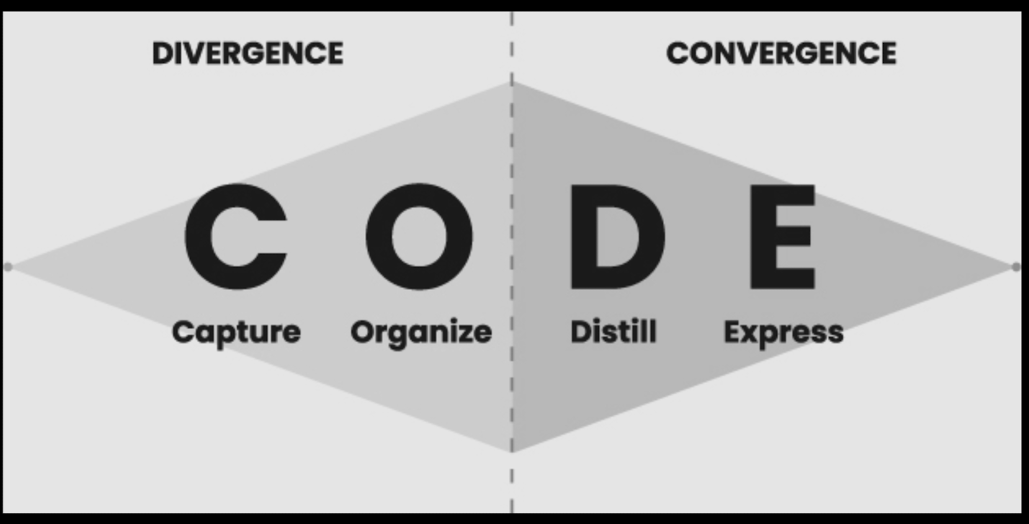
Divergene and Convergence Theory is put forth By IDEO, and according to them its a vital part of a complete creative process.
Divergence
In divergence mode, you want to open up your horizons and explore every possible option. Open the windows and doors, click every link, jump from one source to another, and let your curiosity be your guide for what to do next.
Covergence
Convergence forces us to eliminate options, make trade-offs, and decide what is truly essential. It is about narrowing the range of possibilities so that you can make forward progress and end up with a final result you are proud of. Convergence allows our work to take on a life of its own and become something separate from ourselves. The model of divergence and convergence is so fundamental to all creative work, we can see it present in any creative field.
If you decide to enter convergence mode, do the opposite: close the door, put on noise-canceling headphones, ignore every new input, and ferociously chase the sweet reward of completion. Trust that you have enough ideas and enough sources, and it’s time to turn inward and sprint toward your goal.